26 posts tagged with "actu"

Les actualités diverses de l'IDRIS.

View all tags

Migration of the operating system to Red Hat 9.4

IDRIS
IDRIS
Computing center
⚠ INFORMATION
This page was translated by an AI (LLM) with a cursory human check and is awaiting full review.

Hello,

During tomorrow's maintenance (April 1st, 2025), the operating system of the Jean Zay supercomputer will be updated to Red Hat 9.4 (from 9.2 currently). This update aims to provide a recent software environment on Jean Zay.

This operating system version change should have a limited impact on your use of the machine. The majority of your executables should continue to work without any action on your part; in case of issues, we recommend that you try to recompile your codes.

The GNU compilers bundled with the operating system will be updated to version 11.4.1. The "gcc/11.3.1" module will become an alias for a new "gcc/11.4.1" module to ensure an easy transition.

In case of problems, contact the IDRIS Support.

Best regards, The IDRIS user support team

GPU HPC and AI Hackathon at IDRIS in May 2025

IDRIS
IDRIS
Computing center
⚠ INFORMATION
This page was translated by an AI (LLM) with a cursory human check and is awaiting full review.

For the fifth consecutive year, IDRIS is organising, together with NVIDIA, a GPU HPC and AI Hackathon.

It will take place on 13 May (remotely) and from 20 to 22 May 2025 (on-site at IDRIS). The registration deadline is 4 March.

GPU Hackathons allow teams of three or four developers or researchers to improve the performance of their HPC or AI codes under the guidance of one or more mentors, who are experts in GPU programming and come from universities, national laboratories, computing centres, government institutions and manufacturers.

You do not need to be an IDRIS user to participate in this event, so feel free to share this message with your colleagues. You will have access to IDRIS's computing resources, allowing you to test your code on recent GPUs, including NVIDIA H100s.

For HPC projects, it could be an opportunity to start porting a code to GPU using OpenACC, OpenMP, Kokkos, GPU libraries, CUDA, etc., or to optimise an existing GPU implementation. If your codebase is large, it is recommended to prepare a representative mini-application to be more efficient during the event.

For AI projects, this hackathon offers a unique opportunity to explore fine-tuning, developing or evaluating state-of-the-art models such as LLMs and GenAI applications. You will be able to optimise your models using advanced techniques such as mixed precision, multi-GPU or multi-node parallelisation (DDP, PP, TP, CP), using standard frameworks such as PyTorch or TensorFlow, or specialised tools such as DeepSpeed, Megatron-LM, Nanotron or NVIDIA NeMo. Although full pre-training is out of reach within the hackathon's time frame, preparing a pre-training code for large-scale models is still possible.

Registration is via the event page (in English): https://www.openhackathons.org/s/siteevent/a0CUP00000sO9LV2A0/se000364.

Death of Janine Connes

IDRIS
IDRIS
Computing center
⚠ INFORMATION
This page was translated by an AI (LLM) with a cursory human check and is awaiting full review.

Janine Connes, founder of the CNRS Inter-Regional Electronic Computing Centre (CIRCÉ) in 1969 and its director until 1982, passed away on 28 November 2024 at the age of 98. Together with her husband Pierre Connes, she formed a high-flying scientific duo, with Pierre as the experimenter and Janine processing and analysing the results numerically. This pair established the Fourier Transform Infrared Spectroscopy method, which is of major importance in this field. The page on the University of California Los Angeles website dedicated to Mrs Connes attests to this. She also played a crucial role in the development of numerical simulation in France, enabling the CNRS to acquire the necessary resources to serve all scientific communities. She provides a detailed account of this saga in her book From the IBM 360/75 to the Jean Zay Supercomputer, written with the participation of Françoise Perriquet and published in 2022[^1]. We will briefly recall only the premises and the main stages here.

Licence restrictions for using Alphafold3 on Jean Zay

IDRIS
IDRIS
Computing center
⚠ INFORMATION
This page was translated by an AI (LLM) with a cursory human check and is awaiting full review.

Deepmind has open-sourced Alphafold 3 and made it available on GitHub. However, the model weights are subject to a licence that makes it impossible to provide them to all IDRIS users.

https://github.com/google-deepmind/alphafold3/blob/main/WEIGHTS_TERMS_OF_USE.md

Indeed, a number of people using IDRIS resources are not part of the academic world.

We will contact Deepmind to see if it is possible in our situation to share the weights. While waiting for a response, we will apply the following procedure:

  • IDRIS will install the code so that it is accessible to all users.
  • Each person wishing to use Alphafold 3 must obtain authorisation from Deepmind via the following form https://forms.gle/svvpY4u2jsHEwWYS6. Please note that the response may take up to 2 weeks.
  • The weights must be installed locally on the account of each person wishing to use Alphafold 3.

We have requested the model weights to perform internal tests.

Once these tests are completed, we will publish documentation on the website with all the steps to run Alphafold 3.

Changes and impacts related to the Jean Zay H100 extension

IDRIS
IDRIS
Computing center
⚠ INFORMATION
This page was translated by an AI (LLM) with a cursory human check and is awaiting full review.

This post provides an overview of the ongoing operations for the commissioning of the Jean Zay H100 extension. The information provided here will evolve over time, and we invite you to check back regularly.

H100 Extension of Jean Zay

IDRIS
IDRIS
Computing center
⚠ INFORMATION
This page was translated by an AI (LLM) with a cursory human check and is awaiting full review.

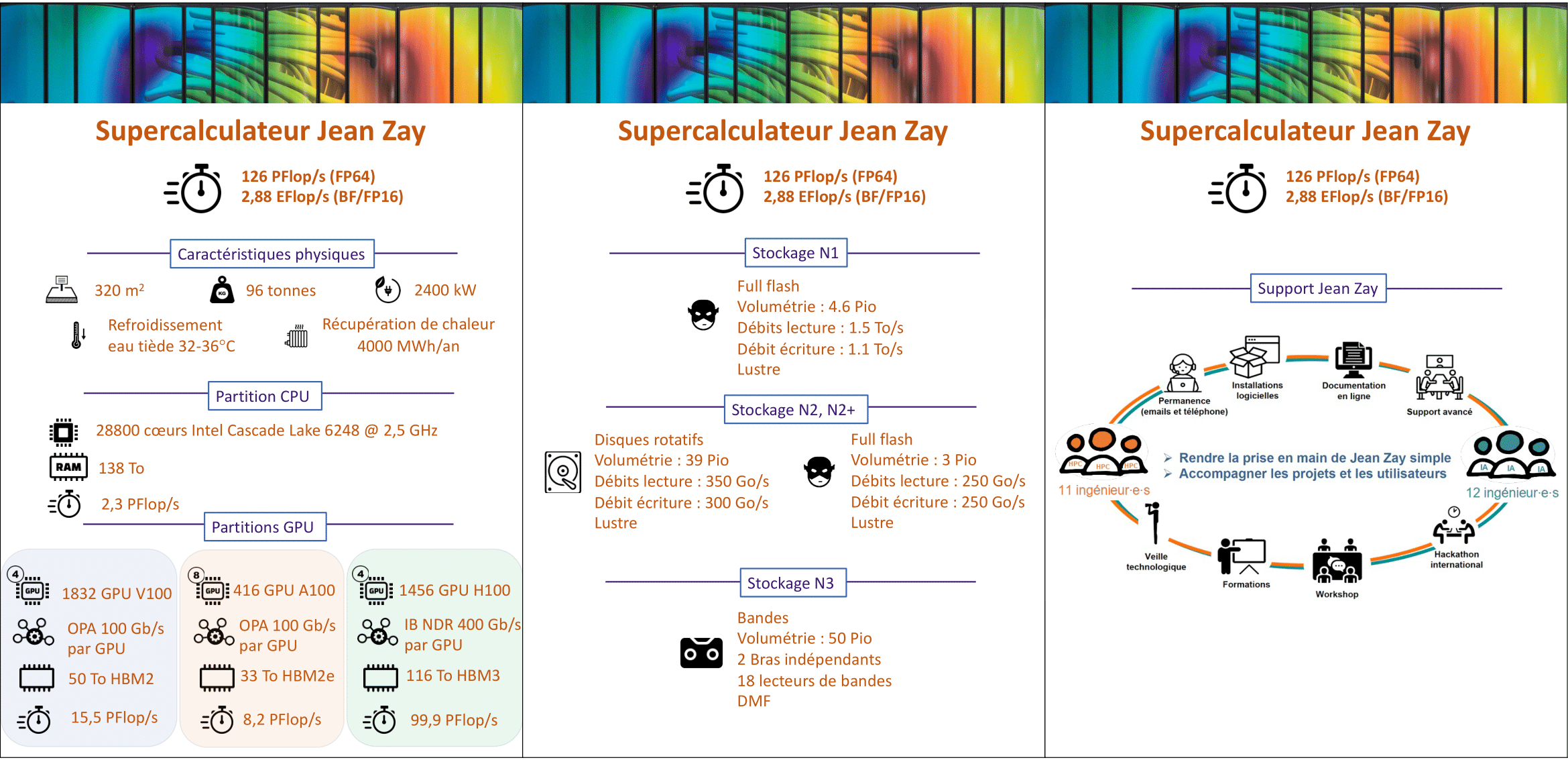
1456 GPU H100 to break the 125 PFlop/s barrier

GENCI and the CNRS choose Eviden to make the Jean Zay supercomputer one of the most powerful machines in France.

Following the announcement by the President of the Republic at Vivatech in June 2023, the National High-Performance Computing Facility (GENCI) and the National Centre for Scientific Research (CNRS), under the leadership of the Ministry of Higher Education and Research, have selected Eviden to provide a major extension of the Jean Zay supercomputer's capabilities, funded under the France 2030 plan.

This announcement marks a new step for sovereign AI.

An official press release is published on the CNRS website: https://www.cnrs.fr/fr/presse/genci-et-le-cnrs-choisissent-eviden-pour-faire-du-supercalculateur-jean-zay-lune-des

Here are the new features of the Jean Zay supercomputer following this extension:

jz-plaquette-3pages

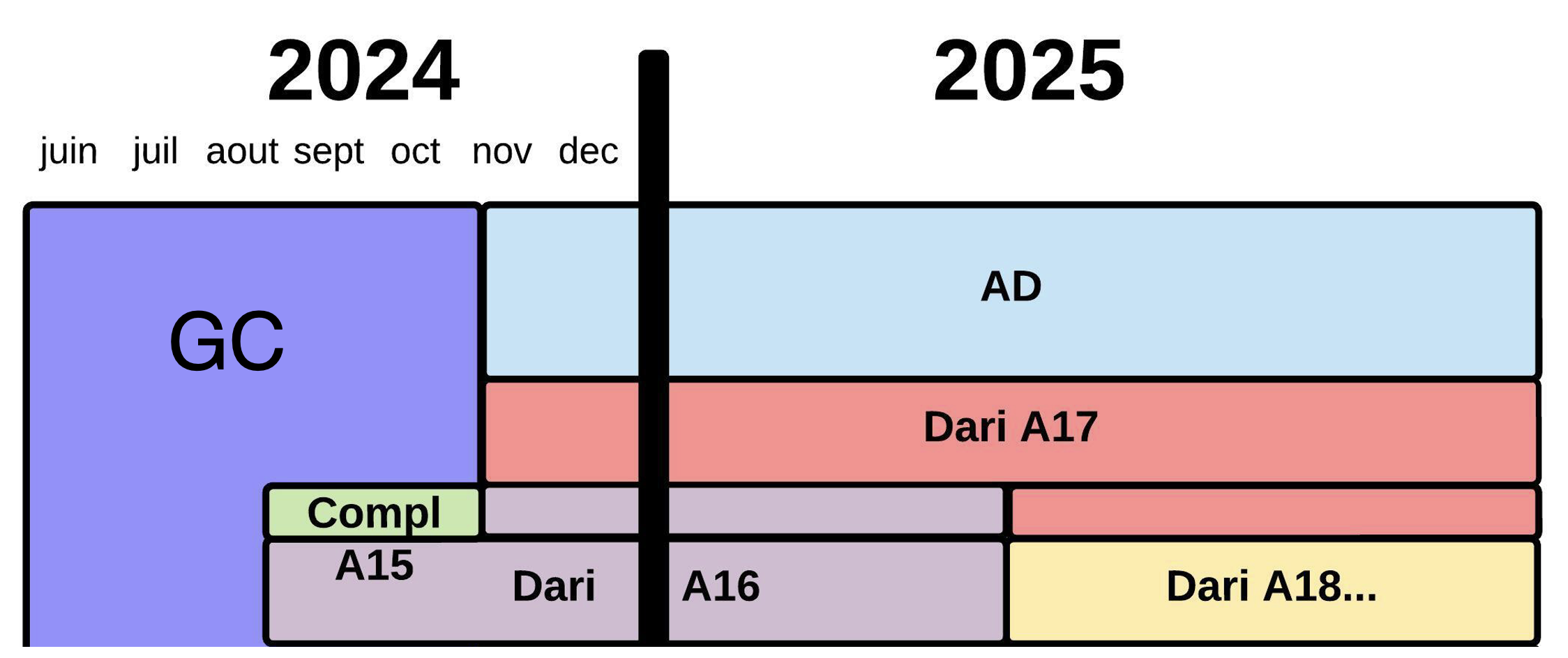
Planned schedule for the commissioning of the H100 extension of Jean Zay:

calendrier-mise-en-service-jz4