This page was translated by an AI (LLM) with a cursory human check and is awaiting full review.
Terms of regulation for computing hours
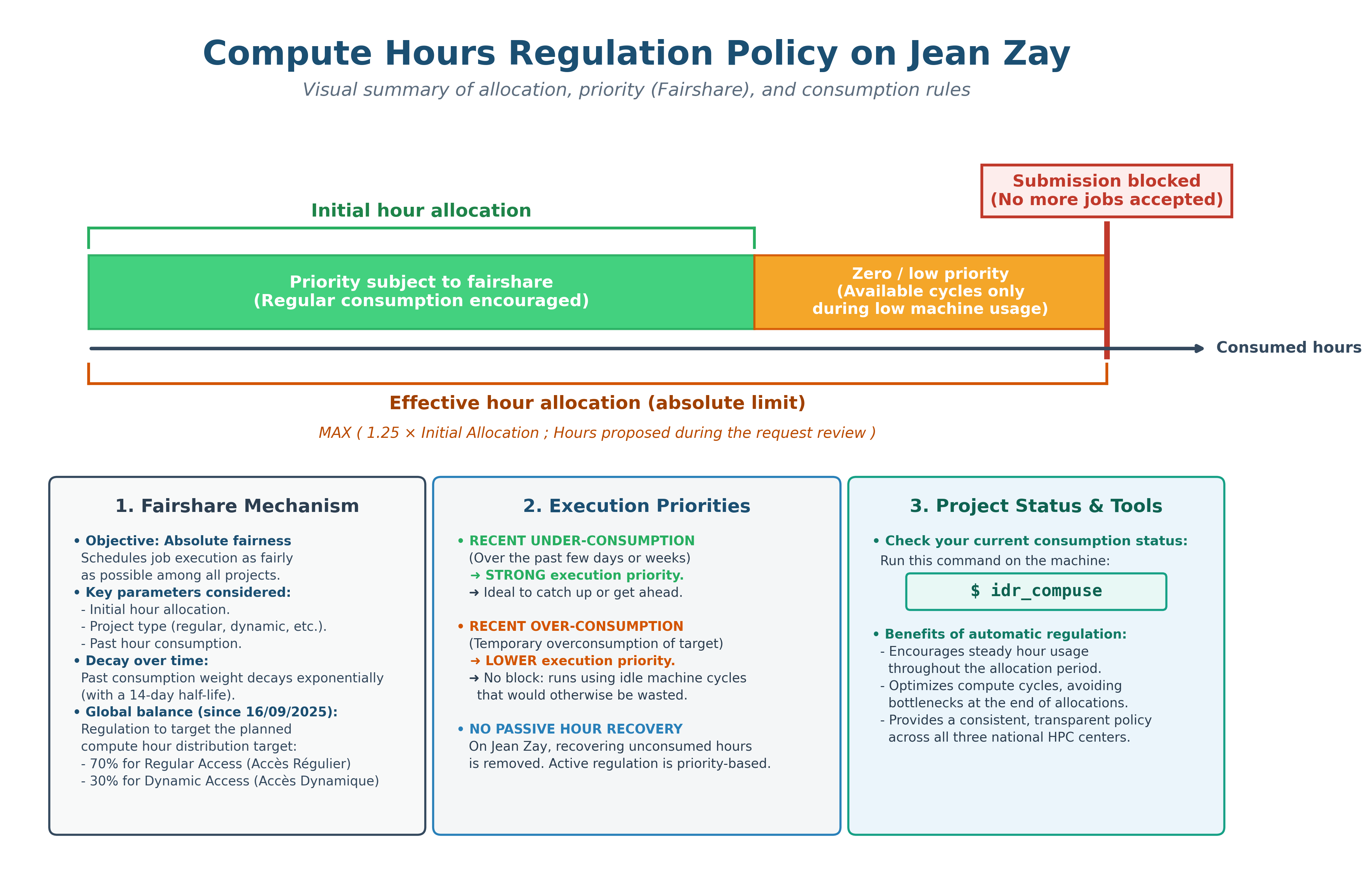
A project that has been granted hours on Jean Zay has an initial hour allocation.
This initial allocation is automatically increased by 25% additional hours (by default) or increased to the number of hours proposed during the hour request review (if the difference between the number of hours proposed and the number of hours initially allocated is greater than 25%). The hours thus allocated in addition to the initial allocation can only be used if the target machine is underutilised, with the jobs having a lower priority as soon as the hour consumption exceeds the initial allocation.
Following this increase, you obtain an effective hour allocation on the Jean Zay machine.
More specifically:
- As soon as a project's consumption exceeds its effective hour allocation, the project is blocked; no member can submit a job.
- A priority system based on a fairshare criterion allows for the most equitable management of job execution on the machine between projects. This system takes into account various parameters, particularly the initial hour allocation, past hour consumption (the effective consideration decreases exponentially over time, with a half-life of 14 days) and the type of project (regular access, dynamic access, etc.).
- A project that has under-consumed in the recent past (the last few days or weeks) benefits from a high priority for the execution of its jobs.
- A project that has over-consumed in the recent past is not blocked; it can continue to submit jobs but with a lower priority. It can therefore benefit from the available cycles on the target machine in case of low load, which would otherwise have been lost.
- Since 16 September 2025, the priority system takes into account the overall consumption of the different types of projects to achieve the theoretical distribution (70% of the hours are allocated to regular access, 30% for dynamic access). For example, if dynamic access has globally consumed more than 30% of the resources recently, its priority will slightly decrease so that regular access can more easily access the resources to reach their consumption target.
- To find out the under- or over-consumption status of your projects, you can run the following command:
idr_compuse
This priority system maximises the effective use of the supercomputer's cycles:
- By encouraging projects to use their hours regularly throughout the year to benefit from a maximum number of hours with high execution priority.
- In case of underutilisation of the machine, projects can either catch up on their backlog or get ahead by benefiting from a lower execution priority, with no hour limit other than the effective hour allocation.
Note that on the supercomputers installed at IDRIS before Jean Zay, a mechanism for reclaiming computing hours had been implemented: in case of under-consumption of hours, projects that had obtained a significant allocation could then lose hours. On Jean Zay, this mechanism is removed and replaced by the automatic regulation described above, which allows for a homogeneous policy across the three national centres.
For any questions regarding the accounting of consumed hours and the monitoring of hour consumption on Jean Zay, you can consult this documentation.