This page was translated by an AI (LLM) with a cursory human check and is awaiting full review.
IDRIS Staff
Organisation
To fulfil its missions, IDRIS is organised into teams, coordinated by the management, as follows:
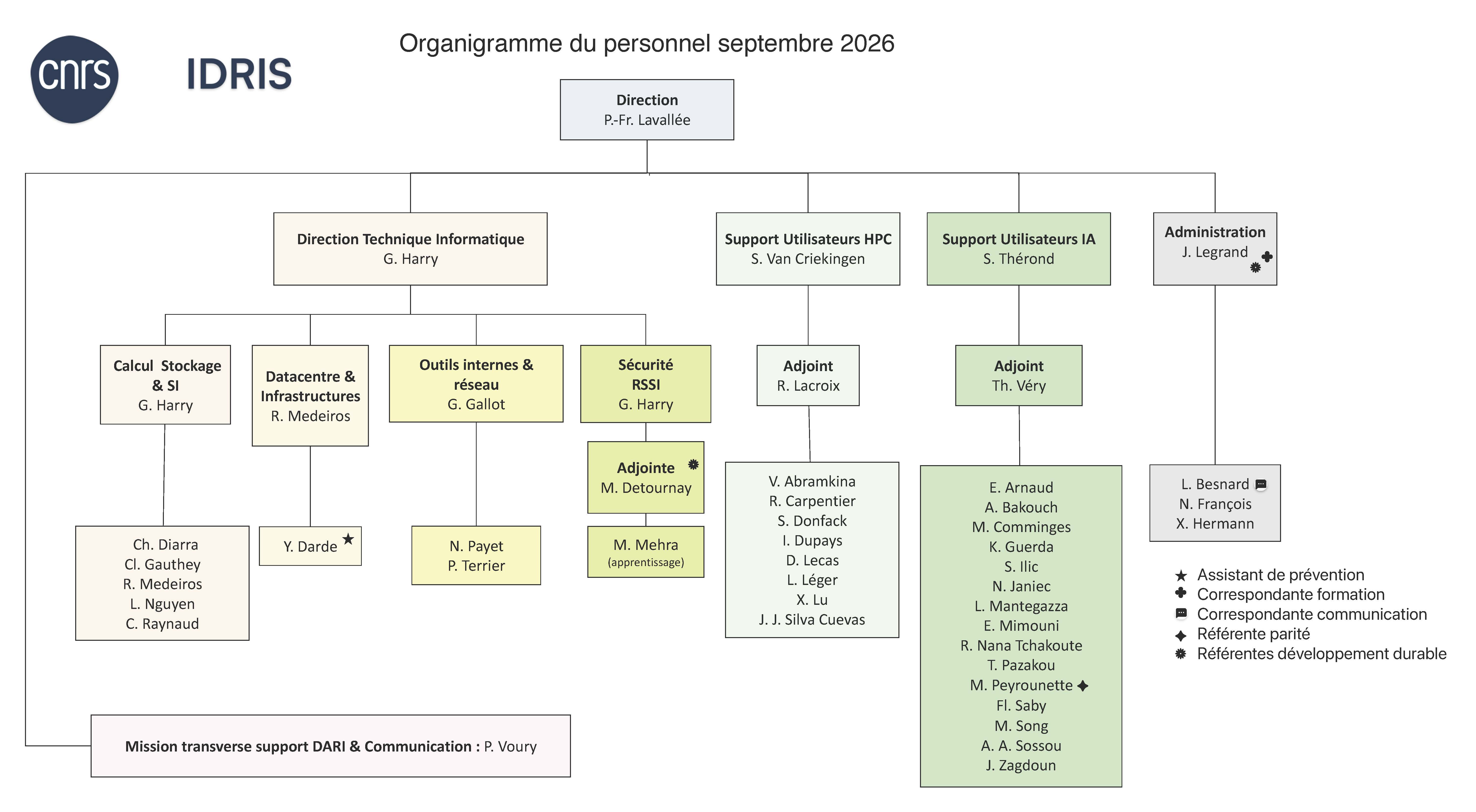
- Direction
- IT Technical Department
- HPC User Support
- AI User Support
- Administration
Pierre-François Lavallée
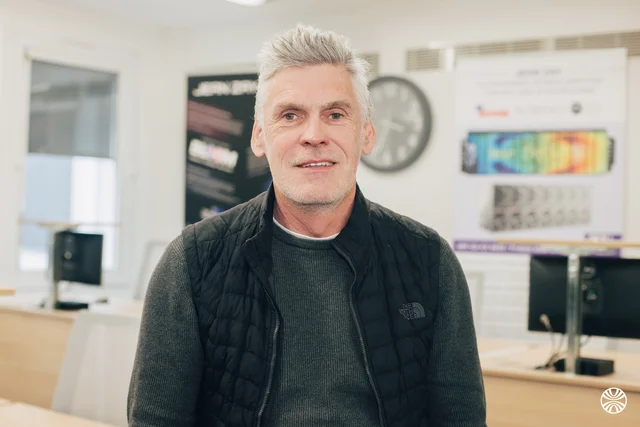
Pierre-François Lavallée joined the CNRS in 1998 as a research engineer in the IDRIS user support team, which he has headed since 2005, after completing a multidisciplinary training in applied mathematics, scientific computing and mechanics, and then obtaining a PhD in computer science from Inria. In direct contact with users accessing IDRIS computing resources, he works on a wide range of complex technical topics, from code optimization on vector architecture at the beginning of his career, to massively parallel high-performance computing, and today focuses on accelerated hybrid computing and the convergence between intensive computing and artificial intelligence. A major player in technology watch on these themes, both nationally and at the European level (DEISA, PRACE, EOSC), he has regularly contributed to numerous educational training actions and scientific presentations.
He has been the director of IDRIS since January 1, 2020.
IT Technical Department
The technical department, composed of system, network, and IT security experts, is responsible for:
-
hosting and ensuring the operational and security maintenance of the IT resources made available to the user community.
-
participating in defining the specifications for new services and the software developments necessary for their implementation, both nationally and at the European level if necessary;
-
monitoring and developing the technical infrastructures and the building in order to support the hosting of new configurations or new services.
HPC User Support
The High-Performance Computing User Support team (SU-HPC) shares with the Artificial Intelligence User Support team (SU-IA) the role of primary interface between IDRIS and its users. Its mission is to help researchers make the most of the intensive computing resources available at IDRIS.
To this end, basic services are maintained by the team:
- an email and telephone helpdesk
- the website (www.idris.fr) designed as a knowledge base for users
- the installation and maintenance of scientific software and libraries
These services are shared with the SU-IA team, allowing efforts to be pooled while taking advantage of the many points of convergence between HPC and AI regarding the use of computing resources.
In addition, the SU-HPC team offers training on code parallelization paradigms (MPI, OpenMP, OpenMP GPU and OpenACC for accelerated architectures), specific training (debugging, vectorization, PETSc library, ScaLAPACK and MAGMA libraries) as well as training in Modern Scientific C++. The team also offers a generalist workshop on code porting and optimization on the Jean Zay machine. The complete catalog is available on the Training page.
Beyond direct support and training, the SU-HPC team can also offer more advanced help with code porting (transition to massive parallelism, GPU porting and optimization, CPU vectorization and optimization, management of parallel I/O, use of libraries) in order to scale up applications. This can take the form of advanced support specific to IDRIS, but also in the form of a European project.
Finally, the SU-HPC team ensures a technology watch on the advancement of HPC technologies, notably carrying out test benches of new architectures within this framework.
AI User Support
The Artificial Intelligence User Support team (SU-IA) shares with the High-Performance Computing User Support team (SU-HPC) the role of primary interface between IDRIS and its users. Its mission is to help researchers make the most of the intensive computing resources available at IDRIS.
To this end, basic services are maintained by the team:
- an email or telephone helpdesk
- the website (www.idris.fr) designed as a knowledge base for users
- the deployment and maintenance of software layers used in AI (TensorFlow, PyTorch, NeMo,...)
These services are shared with the SU-HPC team, allowing efforts to be pooled while taking advantage of the many points of convergence between AI and HPC regarding the use of computing resources.
In addition, the SU-IA team offers training to support the uses of the Artificial Intelligence community: Practical Introduction to Deep Learning (IPDL), Deep Learning Architectures (ArchDL) and Optimised Deep Learning on Jean Zay (DLO-JZ). Personalized support sessions are also offered with the Deep Learning Launch Workshop. More advanced help can be provided as part of an advanced support specific to IDRIS, or as part of European projects like MINERVA.
Finally, the SU-IA team ensures continuous technology watch on the latest computing and software technologies.
Administration
The administration team is responsible for the administrative management of human resources, finance, logistics, partnerships, training provided at IDRIS, projects and accounts of computing resource users, virtual access authorizations to the supercomputer, and physical access to the building, as well as the organization of the unit's communication actions.